Why Does Oak Crack After Being Installed?

July 06, 2026
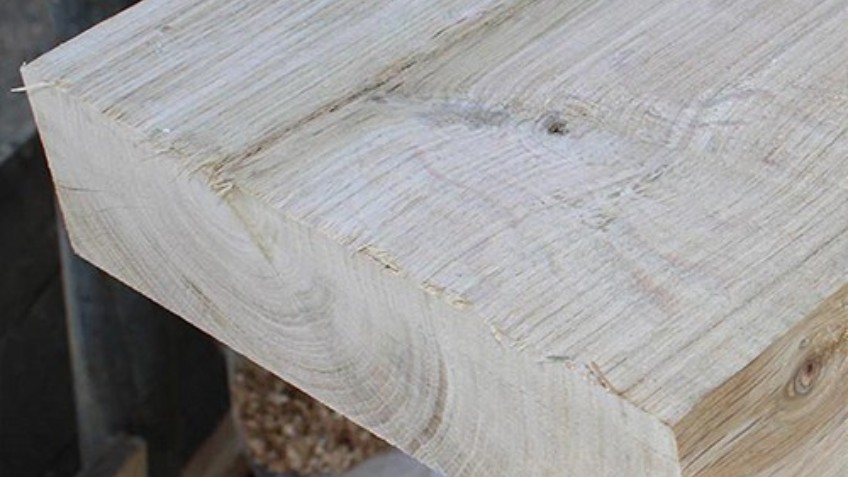
There comes the time when you discover a crack appeared somewhere in your newly installed oak beams, cladding, flooring, mantels or fencing and panic starts creeping in… The first reaction is confusion and concern, then comes Google at 11 PM to figure out whether you've made a terrible mistake.
No worries! Nothing terrible has happened to your wood, and after reading this guide you'll most likely start liking cracks in oak rather than fearing them.
These terms are often used interchangeably and we do use them ourselves too. However, in the timber industry each of these terms refers to something different:
Checks are the most typical thing you can see in your newly installed solid oak. These are the cracks developing on the surface of a board or a beam along its grain. These are the shallow cracks, not exceeding few millimeters in depth. This phenomenon occurs due to the faster drying of the outside layers of the timber. Checks are absolutely harmless.
Splits are the cracks which tend to be deeper and occur near the end of the beam. As moisture evaporates faster from the ends of a board or a beam, the splits develop there. Although it might be rather frightening, especially when you have a big beam, this type of crack is also harmless.
Shakes are the similar phenomenon which involves separating of the wood along its annual rings. Sometimes this separation exists already when you mill the timber, sometimes it develops later. Ring shakes and star shakes are the normal features of solid oak, especially of the large sections.
All these phenomena occur when working with genuine solid timber. You're bound to see them sooner or later. The only way to have a perfectly uniform and crack-free "oak" surface is to use oak-effect boards, which are not the real oak of course.
Solid oak is hygroscopic and therefore reacts to the moisture changes in its surroundings. It means that humidity level in your house, distance to the nearest heat source, season, even opening or closing of the window — all of these factors affect the moisture content in your beams or planks.
When oak dries out, it shrinks. It shrinks unevenly though, as the outside layers of the timber dry out faster than the inside ones. This difference creates a stress in the wood, which leads to developing of checks. The timber literally pulls itself apart in an effort to stabilise.
The process is most active during the first 12-18 months after installation. Fresh sawn (green) oak is the most susceptible to this phenomenon as its moisture content can reach 50-70%. This type of oak needs a long time to dry out fully, especially when placed inside the centrally heated house with rather low humidity.
Air dried oak has much lower moisture content (typically 20-30%) as this timber is stored outdoors for 3-5 years. Therefore, this type of oak dries out and reacts a bit slower. The most stable type of oak is kiln dried one which has its moisture content reduced to 18% or below.
Mainly, yes. The most drastic movement — the deep end splits, wide surface checks — happens in the first 12-18 months when the timber adapts to the new environment. When the moisture content of the timber becomes stabilized, the timber becomes much less active.
That said, the oak will keep reacting to the seasonal changes indefinitely. In the centrally heated house, you'll notice slight differences between summer and winter which is quite normal and one of the reasons why the natural timber looks alive unlike the engineered and composite one.
Nothing should be done for the most part. The surface checks do not require treatment — they are the natural feature of solid timber and not defects. Using the flexible filler to cover the surface cracks often leads to rather poor-looking result as this filler does not move along with the timber.
If you have some particularly wide split on the beam end that troubles you aesthetically, you can cover it with the flexible oak-coloured filler — but structurally it makes no difference. For the mantel pieces and internal joinery, oiling or waxing the timber before and after installation helps to reduce the rate of the moisture exchange and to decrease the intensity of the checks. Though it will not stop them completely.
One thing that you should not do in any circumstances is to make the drying process quicker by putting the fresh sawn beam next to the radiator or in direct sunlight. This rapid and uneven drying increases the severity of the checks and splits significantly. Let the timber adjust gradually and it will stabilize nicely.
The checks, splits and shakes in the oak are the signs of the genuine solid timber that does what solid timber usually does. Each and every beam, board or mantel with these signs proves the genuineness of the product. The product which never cracks, never moves and looks the same year after year is not the real wood — it is photo-printed imitation.
If you've bought the oak from us and now see the surface checks developing, that's the natural process of adjusting of the timber to its new environment. It will stabilise. It will gain the character. In 10 years' time, these small cracks and the patina developed around them will make your oak look like it's been always there.
That's exactly the point!